 Skip-the-line available
 Dolmabahçe Palace History and Highlights
From a sultan's 19th-century vision to the room where Atatürk's clock stopped at 09:05.
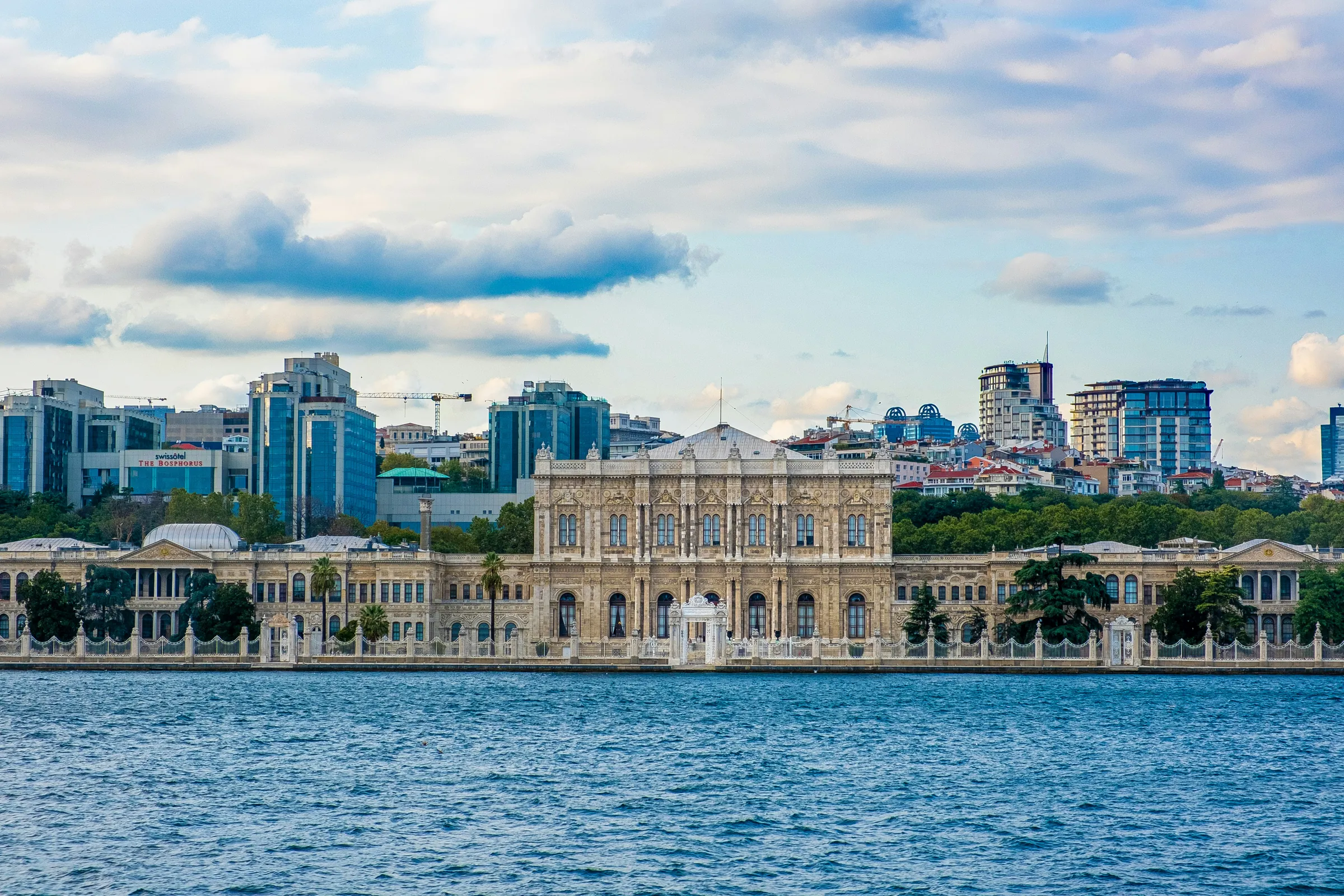
Dolmabahçe Palace was built between 1843 and 1853 for Sultan Abdülmecid I, who wanted a European-styled seat to replace the older Topkapı complex. At 45,000 square metres, with 285 rooms and 46 halls, it is the largest palace in Turkey, and its scale marks the moment the late Ottoman court turned decisively toward the West. It served six sultans and, later, as a presidential residence: Mustafa Kemal Atatürk spent his final months here and died on 10 November 1938. This guide covers the building's origins and its Armenian Balyan architects, the Crystal Staircase, the Ceremonial Hall and its 4.5-tonne chandelier, and the Harem where Atatürk's clock still reads 09:05.
When was Dolmabahçe Palace built, and by whom?
Dolmabahçe Palace was built between 1843 and 1853 for Sultan Abdülmecid I, the 31st Ottoman sultan, who wanted a modern, European-styled residence to replace the older Topkapı Palace. The design came from the Armenian Balyan family of imperial court architects, chiefly Garabet Balyan and his son Nigoğayos, working with Evanis Kalfa, who fused Baroque, Rococo, and Neoclassical styles with Ottoman tradition. The result was Turkey's largest palace, 45,000 square metres containing 285 rooms, 46 halls, six hammams, and 68 toilets. The cost was staggering: reported at five million Ottoman lira, equivalent to some 35 tonnes of gold, roughly a quarter of the empire's yearly tax revenue. That expense captures the ambition and the strain of the late Ottoman state at once. The palace name means "filled-in garden," recalling the bay on the Bosphorus that was reclaimed to create the site.
The site of Dolmabahçe Palace was originally a bay on the Bosphorus used to anchor the Ottoman fleet, gradually reclaimed during the 18th century into an imperial garden, which gives the palace its name, "filled-in garden." When Abdülmecid I commissioned the new residence in the 1840s, the empire was reforming along Western lines, and the palace's European architecture was itself a political statement of modernisation. Six sultans lived here between 1853 and 1924, the last being Caliph Abdülmecid II. In 1924 the young Turkish Republic transferred the palace to the state, and it later opened as a museum under the Directorate of National Palaces. The building's two wings, the public Selamlık and the private Harem, were kept strictly separate, mirroring Ottoman court life. Standing on the European shore in Beşiktaş, the 110,000-square-metre complex remains the grandest surviving statement of the late Ottoman world.
What is the Crystal Staircase?
The Crystal Staircase is the signature flourish of Dolmabahçe Palace's state Selamlık wing, a double-horseshoe stair whose balusters are made of Baccarat crystal, set with brass and mahogany. It rises between the ground-floor reception spaces and the upper ceremonial rooms, catching the light so the whole flight seems to glow, a piece of pure 19th-century theatre designed to impress arriving dignitaries. The Selamlık was the public face of the palace, the wing where the sultan received ambassadors and conducted affairs of state, and its rooms are the most lavishly decorated. Crystal from the French Baccarat and Bohemian workshops appears throughout the palace, from chandeliers to candelabra to this remarkable staircase. Our concierge tip is to pause on the landing and look up: the crystal balustrade against the painted ceiling is one of the building's finest views. It sets the tone for the grandeur that follows.
The state Selamlık of Dolmabahçe Palace was the ceremonial and administrative heart of the building, the southern wing where the sultan met foreign envoys and held court, kept strictly separate from the private Harem to the north. Its reception rooms are dense with gilding, European furniture, Bohemian and Baccarat crystal, Hereke silk carpets, and painted ceilings in the Baroque and Rococo manner the Balyan architects favoured. Fourteen tonnes of gold were used to gild the ceilings across the palace, and the effect in the Selamlık is deliberately overwhelming, a display of the empire's reach and its aspiration to European splendour. Visitors follow a guided route through these rooms, culminating in the vast Ceremonial Hall. The Selamlık is ticketed separately from the Harem, so it forms a distinct stage of any visit. Take the route slowly: the density of decoration rewards a careful eye more than a quick pass.
How big is the Ceremonial Hall and its chandelier?
The Ceremonial Hall (Muayede Salonu) is the climax of Dolmabahçe Palace, a vast reception space of about 2,000 square metres beneath a dome that rises 36 metres above the floor. From that dome hangs the palace's most famous object: a crystal chandelier of some 750 lamps weighing about 4.5 tonnes, often described as one of the largest crystal chandeliers in the world. The hall was designed to host state ceremonies and holiday receptions, its scale meant to awe visiting dignitaries and project imperial power. A long-held story claimed the chandelier was a gift from Queen Victoria, but a receipt discovered in 2006 showed the sultan had in fact purchased it. Standing beneath 4.5 tonnes of suspended crystal in a room the size of a cathedral is the single most memorable moment of most visits. Look up, then out: the hall opens toward the Bosphorus through tall windows.
The Ceremonial Hall anchored the divide between the two wings of Dolmabahçe Palace, standing between the state Selamlık and the residential Harem, and it was heated by a system beneath the floor so it could host winter receptions. Its 56 columns and 36-metre dome create a sense of soaring space unusual in Ottoman architecture, reflecting the European models the Balyan architects drew on. The great chandelier of about 750 lamps and 4.5 tonnes dominates the ceiling, one of a series of Bohemian and Baccarat crystal fixtures throughout the palace. This is where sultans received holiday homage and, in the Republican era, where state occasions were held. Because the hall sits at the joint of the building, it is the natural high point of the guided route, reached after the Selamlık's reception rooms. Our concierge recommendation is to save your fullest attention for this room; nothing else in the palace matches its scale.
What happened in Atatürk's room?
Mustafa Kemal Atatürk, founder of the Turkish Republic, used Dolmabahçe Palace as a residence in his later years and died there on 10 November 1938 at 9:05 in the morning, in a bedroom in the former Harem wing. In his memory, clocks in the palace were stopped and set to 9:05, and the clock in his death room still displays that time, making the small, sober bedroom one of the most visited and moving spots in the building. The room contrasts sharply with the gilded grandeur of the Selamlık: it is plain, personal, and draped in a Turkish flag. Every year on 10 November at 9:05, the nation pauses to mark the moment. For Turkish visitors especially, this room is the emotional centre of the palace. It is reached within the Harem wing, which is ticketed separately from the state rooms.
The Harem of Dolmabahçe Palace was the private residential wing, the northern half of the building, comprising eight interconnected apartments for the sultan, his family, and household, and it is kept structurally separate from the public Selamlık. Beyond Atatürk's bedroom, the palace also houses the National Palaces Painting Museum in the former Crown Prince quarters (Veliaht Dairesi), displaying more than 200 oil paintings, including works by the celebrated marine painter Ivan Aivazovsky. The Harem's rooms are more domestic in scale than the state wing but still richly furnished, showing how the imperial family actually lived. Because the Harem is a distinct ticketed section, plan to visit both wings to see the full contrast between ceremony and private life. Our concierge tip is to end in the Harem, finishing at Atatürk's room, so the visit closes on its most human note rather than its grandest.
Who lived at Dolmabahçe Palace after the sultans?
After the sultans, Dolmabahçe Palace passed into the hands of the young Turkish Republic, which took ownership when the caliphate was abolished and the imperial family left in 1924. Six sultans had lived here between 1853 and 1924, the last royal resident being Caliph Abdülmecid II. Under the Republic the palace served as a residence and workplace for Mustafa Kemal Atatürk, the nation's founder, who used it when in Istanbul and received guests in its grand halls. It was here, in a modest bedroom in the former Harem, that Atatürk died on 10 November 1938 at 9:05 in the morning. The palace thus spans two eras in a single building: the last decades of Ottoman rule and the first years of the Republic. Today it is open to the public as a museum under the Directorate of National Palaces, preserving both chapters of its history.
The transition of Dolmabahçe Palace from imperial residence to public museum mirrors the wider story of modern Turkey. When the Ottoman monarchy ended and the last caliph departed in 1924, the building's political role changed overnight, yet its rooms were preserved rather than dispersed. Atatürk's use of the palace in the Republican era gave it a second life as a stage for the new state, and his death here in 1938 sealed its place in national memory; palace clocks were set to 9:05 in tribute. In later decades sections opened to visitors, and the former Crown Prince quarters became the National Palaces Painting Museum. Our concierge tip is to keep both eras in mind as you walk the rooms: the gilded Selamlık speaks of empire, while Atatürk's plain bedroom speaks of the Republic. Few buildings hold the two so closely side by side.
Frequently asked
When was Dolmabahçe Palace built?
Between 1843 and 1853, for Sultan Abdülmecid I. It was designed by the Armenian Balyan family of court architects to replace the older Topkapı Palace with a modern, European-styled imperial residence.
Who designed Dolmabahçe Palace?
The Armenian Balyan family of Ottoman court architects, chiefly Garabet Balyan and his son Nigoğayos, working with Evanis Kalfa. They blended Baroque, Rococo, and Neoclassical styles with Ottoman tradition.
How big is Dolmabahçe Palace?
It covers 45,000 square metres and contains 285 rooms, 46 halls, six hammams, and 68 toilets, making it the largest palace in Turkey. The wider waterfront site spans about 110,000 square metres.
How big is the crystal chandelier?
The chandelier in the Ceremonial Hall has about 750 lamps and weighs roughly 4.5 tonnes, among the largest crystal chandeliers in the world. A 2006 receipt showed the sultan purchased it rather than receiving it as a gift.
Where did Atatürk die?
Mustafa Kemal Atatürk died at Dolmabahçe Palace on 10 November 1938 at 9:05 a.m., in a bedroom in the former Harem wing. The clock in that room still displays 9:05 in his memory.
Why do the clocks read 9:05?
When Atatürk died at 9:05 a.m. on 10 November 1938, palace clocks were stopped and set to that time. The clock in his death room still reads 9:05, and the nation pauses each year to mark the moment.
What is the Ceremonial Hall?
The Ceremonial Hall (Muayede Salonu) is the palace's grandest room, about 2,000 square metres beneath a 36-metre dome, hung with the great 4.5-tonne crystal chandelier. It hosted state ceremonies and holiday receptions.
How much gold is in the palace?
Fourteen tonnes of gold were used to gild the ceilings across Dolmabahçe Palace. The building's total cost was reported at five million Ottoman lira, equivalent to around 35 tonnes of gold.
Is there an art museum inside?
Yes. The National Palaces Painting Museum occupies the former Crown Prince quarters, displaying more than 200 oil paintings, including works by the marine painter Ivan Aivazovsky.